

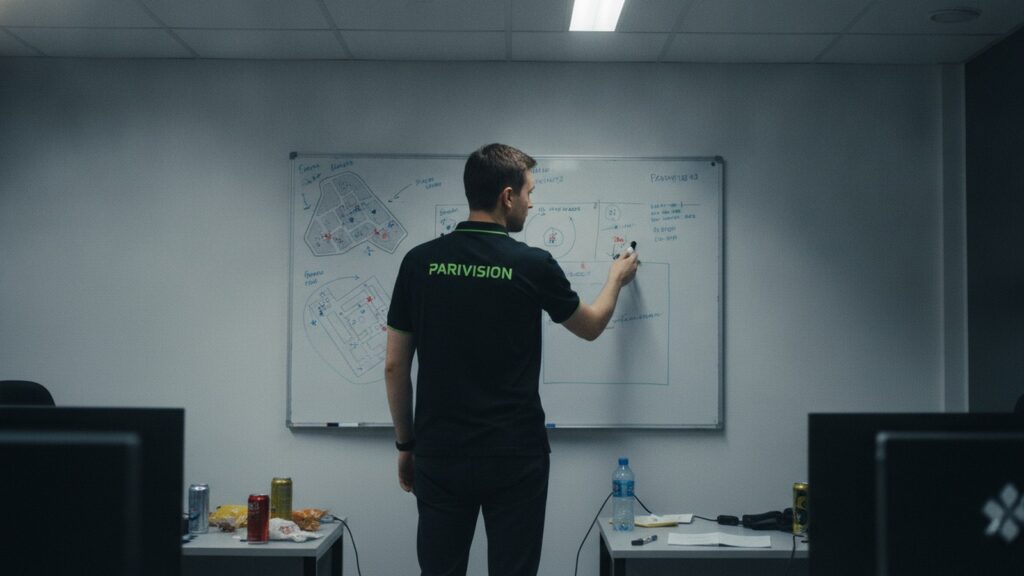
PARIVISION coach Dastan ‘dastan’ Akbayev has opened up about one of the biggest structural challenges behind his team’s rapid 2026 rise: managing a roster built around inexperienced young talent. The Kazakh coach told HLTV that the communication style he developed working with veteran professionals simply wasn’t producing results inside PARIVISION’s current lineup — and walked through what he changed.
The dastan framing
The interview gives rare public insight into the internal development process behind one of CS2’s most talked-about projects. dastan explicitly said his previous communication framework — built around mature, experienced T1 professionals — was structurally mismatched with the PARIVISION lineup. The fix wasn’t tactical; it was leadership-style.
‘Talking to them like grown pros’ (paraphrased) wasn’t producing the response dastan wanted. Younger players, he explained, require different forms of feedback, motivation and guidance. Direct criticism and demanding conversations — the standard T1 veteran-roster default — needed to be replaced with a more graduated approach that prioritised long-term development alongside short-term performance.
Why the PARIVISION roster is structurally young
The lineup is built around Dzhami ‘Jame’ Ali as the veteran in-game leader plus a young supporting core anchored by zweih (18) and others making their first T1 trajectories. zweih’s recent interview explicitly credited Jame as the reason for the move from Team Spirit — calling Jame and chopper the only two CIS captains capable of building a T1 team around young talent. dastan’s coaching role is the structural complement to that calling-layer architecture.
The 9z setback
The Stage 3 opening 0-2 loss to 9z (with luchov’s 2.00 series rating leading the South American carry) is the kind of result that tests dastan’s framework directly. Jame’s late-round impact never unlocked, PARIVISION’s stars produced surprisingly quiet outputs, and the team never established the kind of map control the young carry layer needs. The next Bo3 against Monte is now the test of whether dastan’s adapted communication framework holds under elimination pressure.
The 2026 PARIVISION trajectory
The pre-Cologne results validated the approach:
- Rapid international rise — moved from CIS Tier 2 to T1 conversation across the year
- Stage 3 qualification at IEM Cologne as a pre-seeded contender
- Recent Tier 1 results validating the Jame-led structural identity
- Stable locker-room dynamic visible through the zweih interview and the dastan public framework
The 9z loss compresses the timeline but doesn’t invalidate the structural identity. dastan’s framework was designed for exactly this kind of pressure test.
The wider CIS picture
dastan’s interview is also a structural data point for the CIS Counter-Strike scene as a whole. With Spirit’s donk-led project, NAVI’s Aleksib calling framework and PARIVISION’s Jame-young-core architecture, the CIS region currently produces three distinctly different but simultaneously viable T1 structural models. The talent pipeline is structurally wider than at any point since the s1mple-electronic era — and dastan’s coaching framework is part of why.
