

Last reviewed: August 6, 2026 by the CS2Bet editorial team.
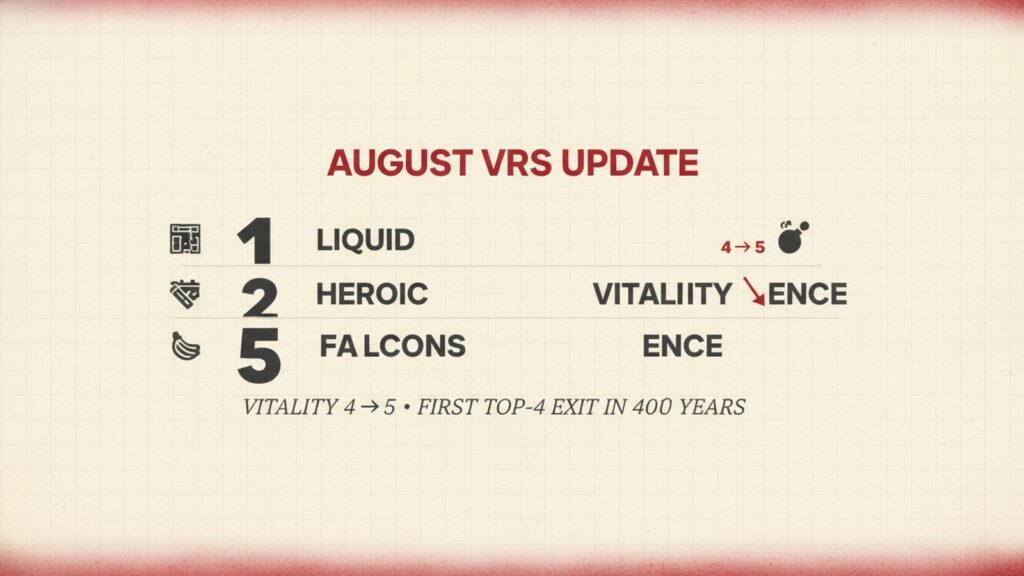
The Valve Regional Standings (VRS) August 2026 update just produced a headline that hasn’t landed in Counter-Strike’s ranking layer in roughly two years. Team Vitality dropped to fifth place globally — the French organisation’s first exit from the top four in one of the longest consistency stretches modern Counter-Strike has produced.
The structural context
The drop is structurally significant even though practically manageable. Valve’s VRS system determines invitations to premier Counter-Strike 2 events, and top-four positioning historically anchors seeded byes and easier bracket paths. Fifth place still qualifies for essentially every T1 tournament — the loss of positioning is more about narrative than access.
Per HLTV’s reporting, the drop reflects Vitality’s post-IEM Cologne Major slowdown rather than a single-tournament exit. The 9z Stage 3 loss compressed the trophy trajectory; the Falcons quarter-final result (and whatever happened in the playoffs the site’s prior coverage didn’t capture) extended the compression into VRS point terms.
What the ranking-model actually reads
VRS points decay across a rolling window. Two years of top-four positioning implies Vitality have been banking VRS at roughly the maximum rate the model allows across the entire measurement period. The August drop specifically requires either:
- Vitality banking fewer new points than the rolling decay rate consumed old points
- Rival organisations (Spirit, MOUZ, NAVI, Falcons, FURIA) banking materially more than Vitality during the Cologne cycle
- Both dynamics compounding, which is the most likely scenario given the Cologne results
The jL stand-in synchronicity
The VRS drop lands in the same week Vitality confirmed jL as the stand-in for apEX and mezii’s paternity-leave coverage. The two storylines feed each other structurally:
- The VRS drop compresses the immediate structural pressure — every event Vitality skip or underperform in scales the ranking penalty
- The jL stand-in mitigates the calendar-gap risk that could have compounded the drop further
- Together they suggest Vitality’s front office read the ranking trend correctly and pre-positioned the roster depth to hold position through the transition
The dynasty-durability read
This is exactly the moment the apEX GOAT-framing arguments get their first genuine structural test. Dynasty status is easier to claim when the trophy cabinet is compounding at maximum rate; the actual credential proof happens when the ranking model starts signaling erosion and the roster has to respond. Vitality’s August VRS position is that moment.
Two structural outcomes are live:
- Recovery path: jL stand-in period produces baseline results, apEX returns from paternity leave, the roster reclaims top-four by end of Q4 2026, the dynasty framing extends cleanly into 2027
- Erosion path: stand-in period compounds the trajectory drift, further personnel-availability issues emerge, and Vitality’s top-four exit becomes the structural inflection point for the era’s end
The ranking-model roadmap
Next Valve VRS update (September) is the concrete signal. If Vitality recover top-four positioning during the jL stand-in period, the drop reads as one-month noise. If they slide further (or hold at fifth), the dynasty-durability question becomes the defining structural narrative of the back half of 2026.